
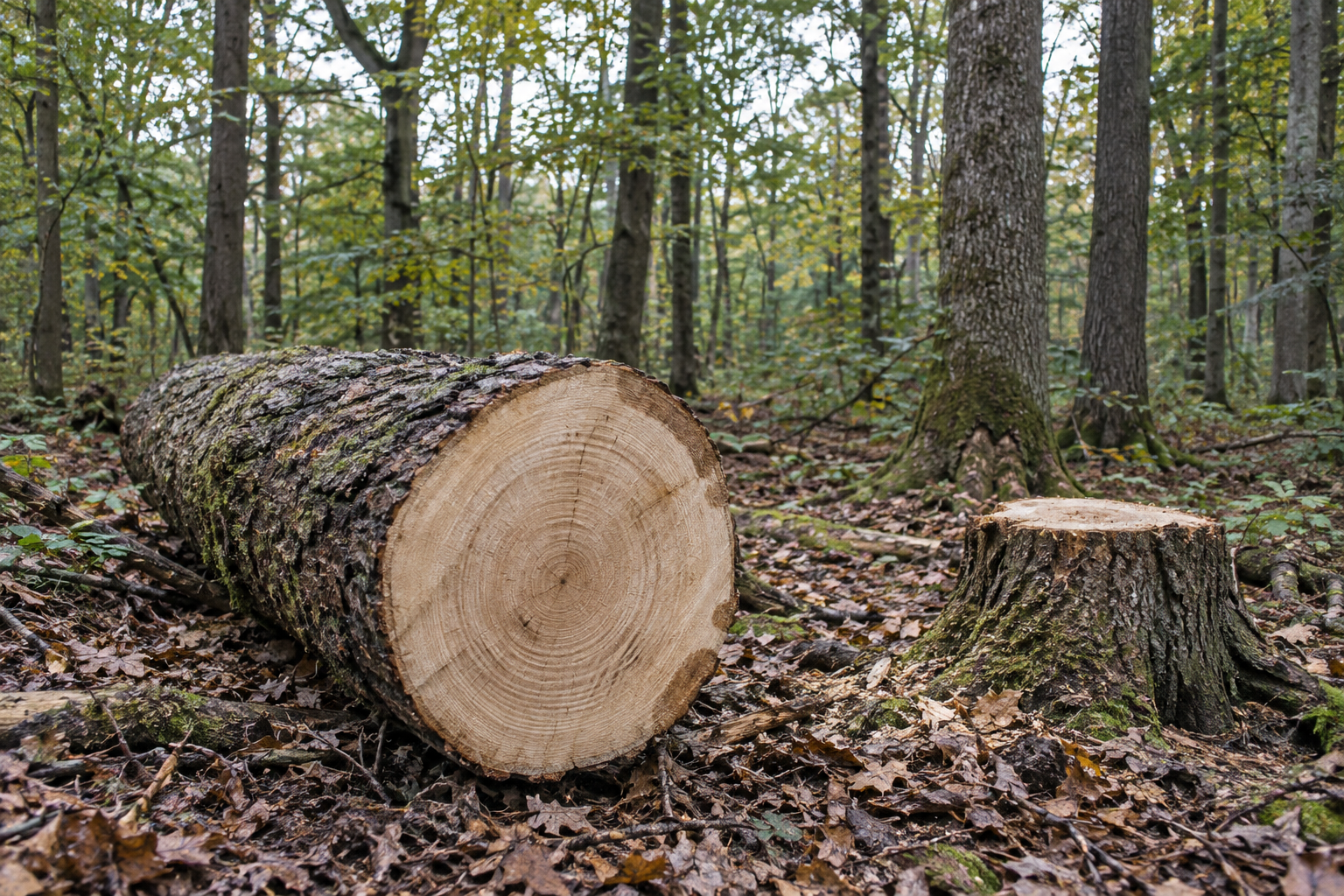
Picture a freshly cut log lying beside a stump. The tree has stopped growing, but the wood is still there. So is much of the carbon it accumulated.
Cutting down a tree does not instantly return all its stored carbon to the atmosphere. What happens next depends on where that carbon goes: into a fire, a decaying log, a wooden beam or another form of storage. Harvesting changes its location and future; release happens through subsequent processes such as combustion and decomposition. The IPCC’s harvested-wood guidance makes this distinction explicit.
That is why the climate story of a planted tree needs to continue beyond the day it is felled. The useful questions are how much carbon remains stored, for how long, and what happens to the forest around it.
First, what is the tree actually storing?
Planting starts a process. A tree must survive and grow to accumulate carbon.
Through photosynthesis, it takes in CO₂ and uses sunlight to build carbon-containing organic matter. The carbon becomes part of the tree’s tissues; it is not held inside the trunk as a reservoir of CO₂ gas. Plants also return some carbon through respiration, so total uptake is different from the amount that remains stored. NASA’s explanation of the carbon cycle describes both directions of this exchange.
There is carbon below the trunk, too. Roots and the surrounding soil belong to the picture. Some plant-derived carbon enters soil organic matter, where its persistence depends on biological processes and environmental conditions. The US Department of Energy’s carbon-storage explainer describes how some soil carbon returns to the air while some remains for much longer.
After harvest, these different stores follow different paths.
Follow one oak to harvest day
Imagine a northern red oak at age 100: 25 metres tall, with a trunk 50 centimetres across at breast height, the measurement foresters call DBH. These are chosen dimensions for our example, not an average growth timetable. Oaks do not all need exactly a century to reach this size.
A published US tree-biomass model by Jenkins and colleagues, combined with an IPCC broadleaf carbon fraction, puts this example at roughly 3,800 kg of CO₂ represented by stored carbon: 3,200 kg above ground and 600 kg in coarse roots. The calculation uses diameter; age and height set the scene. It is an estimate, not a measurement of a particular tree.
That total excludes soil and fine roots, and applies the same carbon fraction to coarse roots as a simplifying assumption. It describes carbon still present at harvest, not all the CO₂ that passed through the tree during its life.
The chainsaw does not release those 3,800 kilograms at once. Nor can a sawmill turn all of them into furniture: roots remain below ground, and the crown, bark and trunk have different destinations.
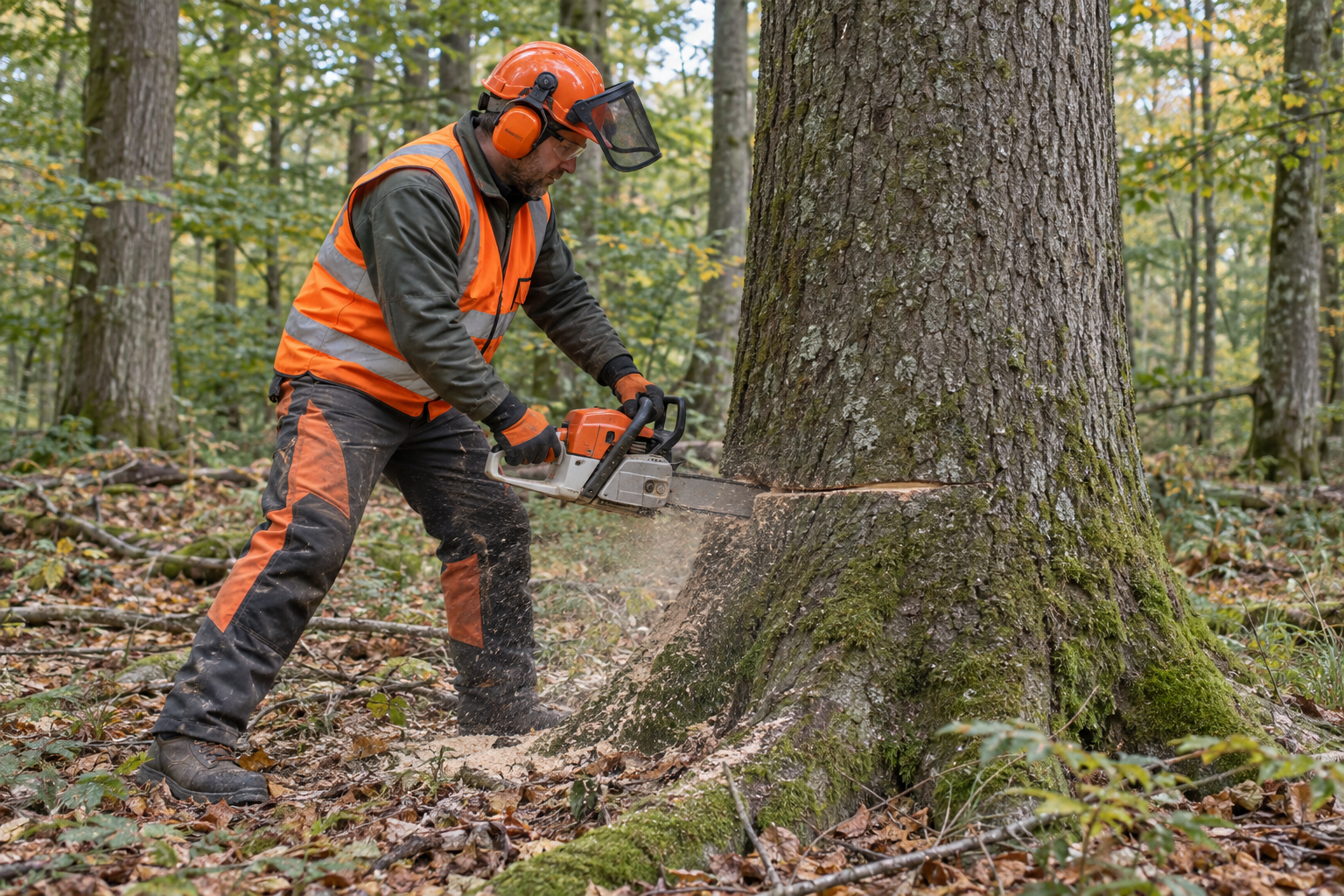
Where does harvested wood go today?
The clearest global starting point is FAO’s forest-product data for 2024. Of 3.905 billion cubic metres of roundwood produced worldwide, 1.949 billion went into woodfuel and 1.956 billion into industrial roundwood. By volume, that is almost exactly half for fuel and half for industrial uses. Woodfuel includes wood for energy and charcoal production; “industrial” does not automatically mean long-lasting storage.
These statistics describe a wood supply, not the eventual carbon balance of every felled tree. They do not provide a single, non-overlapping global split into construction, furniture, paper and permanent storage. Product totals also include successive processing stages and different units, so adding them together would double-count material.
At a sawmill, a log becomes boards alongside chips, slabs and sawdust. A FAO/ITTO/UNECE compilation reports hardwood sawnwood recovery of roughly 45–66% of incoming log volume across the countries shown in its 2018 survey. That is a useful indication of the processing step, not a global average. The remainder is not automatically emitted carbon: residues can become panels, pulp or fuel. Drying shrinkage is not carbon combustion.
Land clearing is another part of the story. FAO’s remote-sensing assessment for 2000–2018 attributed almost 90% of deforestation to agricultural expansion. But that is a share of forest area lost, not the percentage of harvested wood burned. It cannot tell us how many kilograms from our oak would be burned to clear farmland. A reliable global carbon percentage for that route is not established by these data.
If the wood burns, carbon returns quickly
In ordinary burning, without carbon capture, carbon in the wood reacts with oxygen and is released largely as CO₂. The tree’s biological origin does not prevent that release. NASA’s carbon-cycle account includes fire among the processes that return plant carbon to the atmosphere.
Calling the fuel renewable does not establish that its climate effect is immediately neutral. A fair assessment must consider the energy supply it replaces, harvesting and transport emissions, forest recovery and what would otherwise have happened to the land and wood. Those comparisons can lead to different outcomes. The USDA’s review of wood-based bioenergy explains why the full lifecycle matters.
The chimney tells us that carbon has been released. It cannot, on its own, tell us the net climate result.
If the wood decays, the return is gradual and uneven
A log left on the ground remains a carbon store while it breaks down. Decomposition releases carbon to the atmosphere and transfers some into the soil. These are connected processes, described in the US Forest Service’s account of forest carbon cycling.
There is no single expiry date for a fallen tree. Wood and site conditions influence decay and the movement of carbon into soil. A Forest Service decomposition research programme was designed specifically to investigate these interactions across different woods and environments. It would be misleading to assign every log the same lifetime—or assume that everything entering the soil stays there permanently.
Disposal conditions matter as well. Some discarded wood can persist in landfill, while decomposing organic material can generate methane as well as CO₂. Methane is a different greenhouse gas, so a full climate assessment cannot treat every release as CO₂. The IPCC discusses retained carbon in discarded wood, and the EPA explains how landfill conditions affect gas generation.
If it becomes a beam or table, storage can continue
A wooden beam still contains carbon after it leaves the forest. Its use in a building can delay that carbon’s return to the atmosphere.
The duration depends on the product and its fate. Paper generally passes through use much faster than structural timber. Reuse can extend a product’s service, but eventual burning, decay or disposal still belongs in the account. The IPCC’s wood-products chapter explains these differing storage periods.
A beam also represents only part of a harvested tree. Material left at the harvest site and material routed into other products or fuel must be tracked separately.
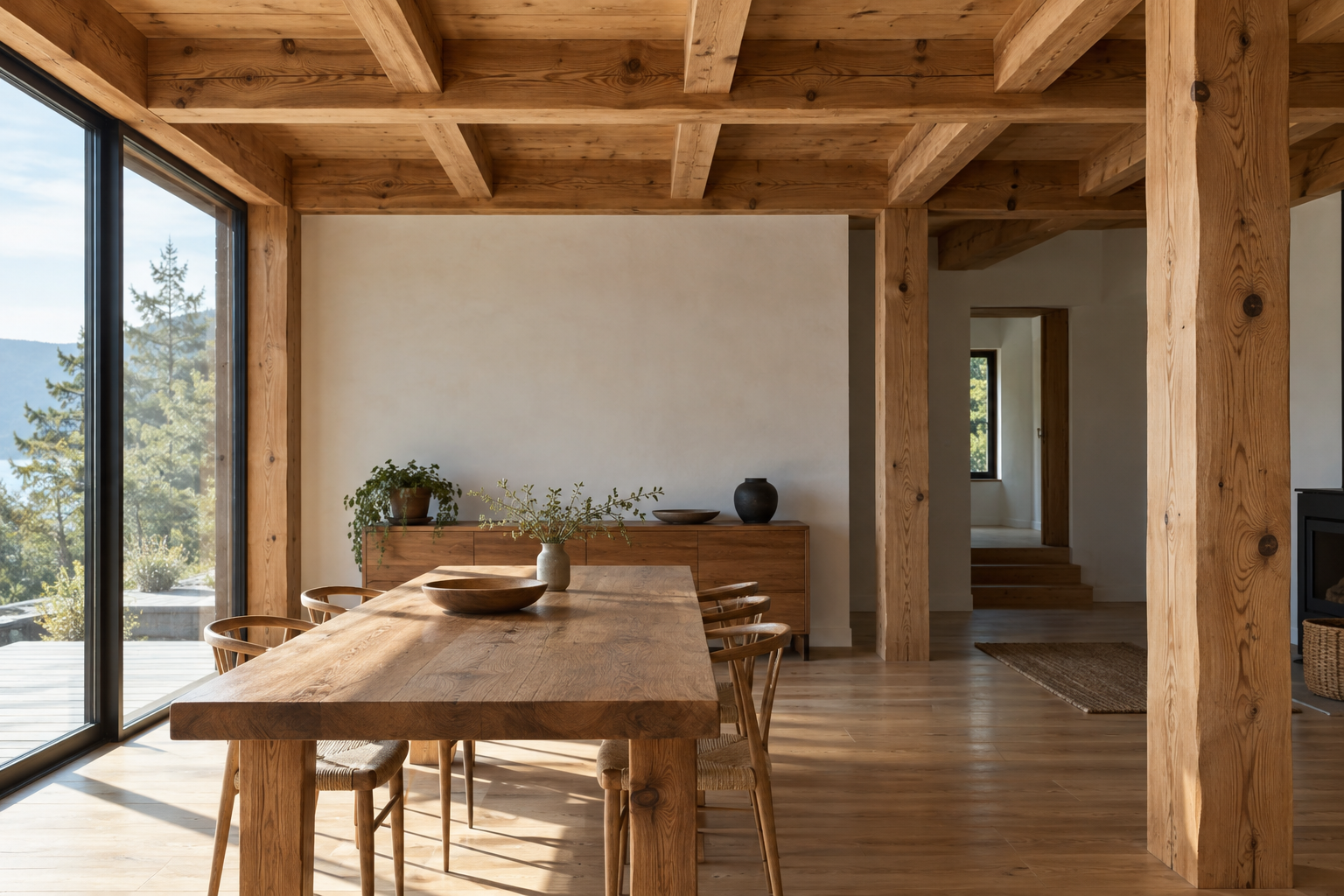
There is a useful accounting distinction here: making the beam transfers carbon that the tree already absorbed. It does not absorb that same carbon from the air a second time. The IPCC’s 2019 guidance explicitly distinguishes atmospheric uptake from transfer into wood products.
Using timber instead of another material may also change manufacturing emissions. That is a separate comparison from storage, dependent on what is actually replaced and how each option is produced. The USDA discusses both effects; one should not be presented as proof of the other.
One tonne of CO₂, followed through time
To make the journey tangible, take a portion of harvested wood containing carbon equivalent to 1,000 kg of CO₂. This is part of our oak’s aboveground store; its roots and soil are outside this example.
Now choose a simple pathway: 500 kg goes to fuel, another 100 kg is burned during processing, 100 kg enters paper, 100 kg enters wood panels and 200 kg enters sawnwood products. In other words, 600 kg returns quickly, 100 kg enters short-lived products and 300 kg enters potentially longer-lived products.
Those allocations are an illustrative scenario, not measured global carbon shares or a forecast for oak timber. The global fuel statistic provides context, but a volume share cannot simply be converted into a carbon share. The extra processing loss and product split are explicit assumptions.
For the products, we can use IPCC accounting defaults: half-lives of two years for paper, 25 for wood panels and 35 for sawnwood. These describe declining pools, not expiry dates for individual objects. A particular oak table might remain in use much longer.
| Time after processing | Still stored in products | Released in this simplified scenario |
|---|---|---|
| At the start | 400 kg | 600 kg |
| After 1 year | About 364 kg | About 636 kg |
| After 5 years | About 286 kg | About 714 kg |
| After 30 years | About 154 kg | About 846 kg |
| After 300 years | Less than 1 kg | More than 999 kg |
Reuse, recycling or landfill storage would change this timeline. The table excludes those routes, methane, regrowth, soil changes and fossil-fuel emissions from operations. It therefore follows the fate of the selected wood carbon, not the net climate benefit of harvesting.
At 300 years, extending these defaults is a thought experiment, not a reliable forecast. And “permanent” has no guaranteed quantity here: a long-lived wooden product postpones release; its existence alone does not establish permanent removal.
Biochar offers another possible destination
Some woody material can be heated with little or no oxygen in a process called pyrolysis. One possible output is biochar, a carbon-rich solid whose properties depend on the feedstock and production conditions. USDA’s biochar overview describes this material.
This can create a route to longer-lasting carbon storage, but the process does not preserve all the original carbon in the char. Pyrolysis also produces gases and liquids. Their fate, the energy used and the durability of the stored material all matter. The Department of Energy’s assessment of carbon-removal technologies describes these outputs and the remaining durability questions.
“Turned into biochar” therefore needs a follow-up: how much carbon was retained, where was it placed, and what evidence supports the claimed storage period?
The forest continues after the trunk leaves
A trunk-only account misses roots, stumps, branches, dead wood and soil. Harvesting can disturb soil and the forest floor, while machinery adds emissions. The magnitude depends on the site and operation; it cannot be inferred from a photograph of a stump. US Forest Service guidance treats these effects as part of forest-carbon management.
New growth can take up CO₂ over time. But a younger, faster-growing stand can still hold less carbon than an older stand. The same guidance distinguishes the rate of uptake from the amount already stored.
This makes “we replanted” an incomplete answer. Regrowth must be considered over time and compared with a credible alternative, including the carbon the forest might have retained without that harvest. That comparison is central to the USDA’s lifecycle discussion.
The ratio ATLAS wants to change
ATLAS’s stated aim is to use plantation-grown wood more efficiently and keep more of its carbon stored for longer. In practical terms, that means directing suitable timber into durable products, reducing avoidable processing losses, and designing products for repair and reuse.
Our example shows why the destination matters. If another 100 kg of that original CO₂ store entered sawnwood products instead of being burned at the start, roughly 55 kg more would remain in use after 30 years under the same assumptions. That is a modeled opportunity, not an ATLAS performance result.
Delivering it would require evidence: where the plantation was established, what land use it replaced, how much wood actually reaches each product, and what happens after use. Growing a plantation and selling timber are steps in that story; a measured, lasting carbon benefit must be demonstrated across the whole lifecycle.
What a tree-planting promise should explain
Taken together, these processes suggest a more useful way to assess a planting claim. Ask what evidence shows that the trees survived and accumulated carbon; what happens to harvested material and residues; how long storage is expected to last; and how losses, regrowth and operational emissions are included.
Those are questions about the whole carbon journey. A planting count answers only its beginning.
For the log beside the stump, the answer remains concrete: its carbon is still in the wood. Its next destination will help determine when—and in what form—that carbon reaches the atmosphere again. Any claim about lasting removal needs to follow it there.